Why am I suddenly leaking urine
Incontinence Advice

In Ihrem Warenkorb:
Es befinden sich noch keine Artikel in Ihrem Warenkorb.
Quantity: ZULETZT HINZUGEFÜGTE ARTIKEL Artikel gesamt: Summe: Zum WarenkorbWe help you
In our FAQ you will find answers to the most frequently asked questions. Here you can also find out the easiest way to contact us.
Customer serviceIncontinence Advice
Are you experiencing urinary incontinence and wondering why? The human urinary system is very complex, involving muscles, hormonal mechanisms, and conscious and unconscious neural pathways. Understanding how the urinary system works can help you better understand your situation.

The body produces approximately 1.5 to 1.8 litres of urine daily, an amount that varies depending on individual fluid intake. We urinate on average 4 to 6 times a day. Urination is the culmination of the urinary system's mechanism, which involves several organs. In this article, we will talk more about how this works.

Diagram of the male urinary system

Diagram of the female urinary system
The kidneys are located under the ribs, on either side of the spine. Their function is to filter and purify toxic waste from the blood. Urine is secreted by the kidneys to eliminate this waste. Each kidney connects to a canal, the ureter (a kind of narrow tube) which allows urine to be carried to the bladder.
Its walls are made up of a powerful muscle called the detrusor. During urination, this muscle propels urine towards the bladder neck. The detrusor can send and receive signals via neurotransmitters. When the bladder is half-full, it sends information to the brain that it's time to visit the toilet, then waits for the brain to give the signal to trigger urination.
During urination, the bladder contracts, the two sphincters act like a tap and open to allow urine to pass through a canal called the urethra.
The urinary system consists of a total of two sphincters, both of which act like a type of lock.
The first sphincter is made up of smooth muscle. This muscle is located at the neck of the bladder and connects to the urethra. It is contracted unconsciously (by the central nervous system) and relaxes naturally when we need to urinate.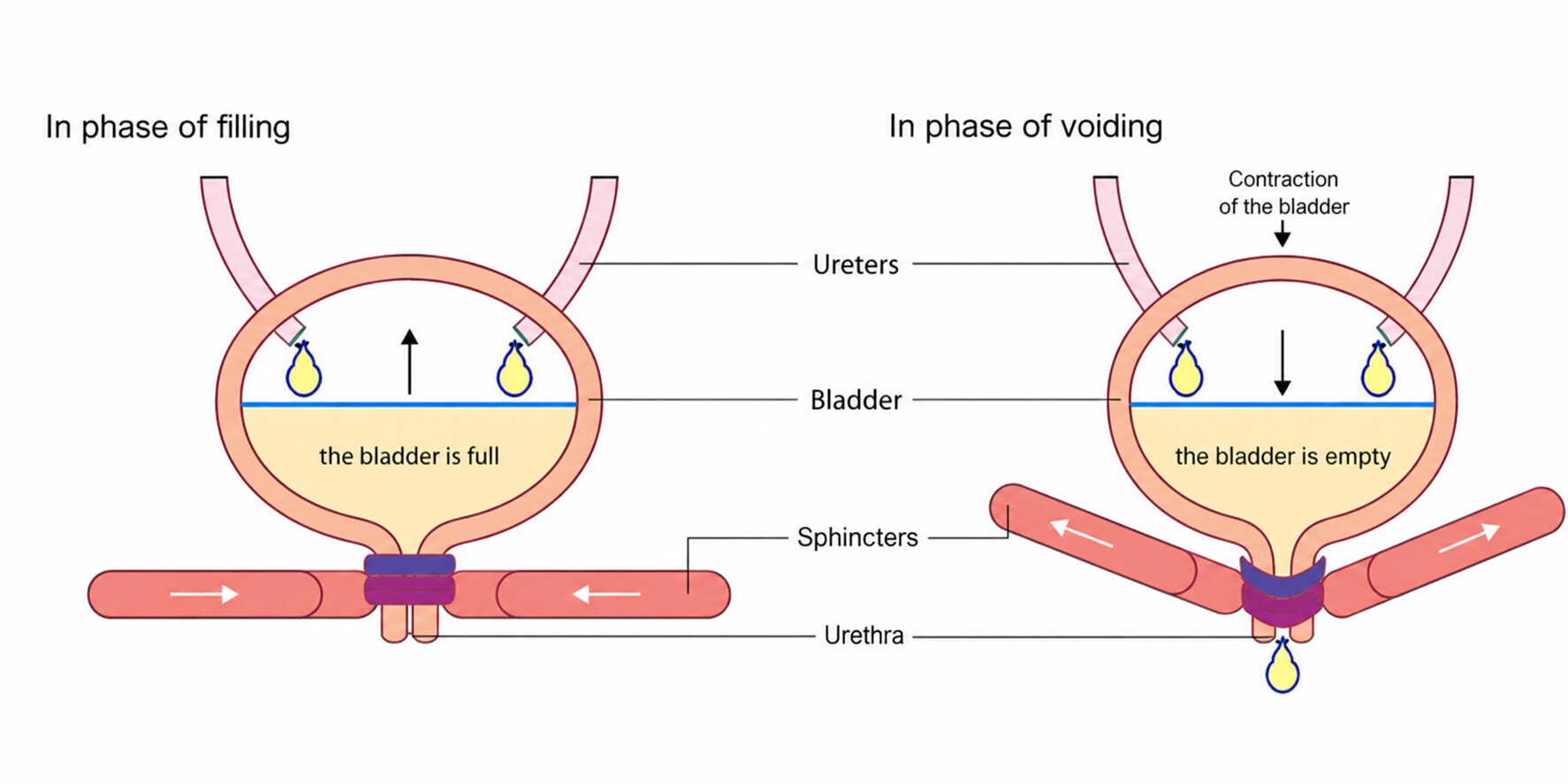
Diagram of the male urinary system
The male and female urinary systems are virtually identical. They differ only in a few details:
Newborns struggle with bladder control and empty their bladder reflexively, without brain intervention. Urine flows when the bladder is full. This mechanism involves only the bladder and the nerves connecting it to the spinal cord. Sensory nerves receive stimulation when the bladder is full. Because these nerves communicate with motor nerves in the spinal cord, they can trigger bladder contraction and relaxation of the bladder sphincter. As a result, urine flows without conscious intervention.
As a child grows, their nervous system begins to receive sensory messages from the bladder. When the brain is sufficiently mature, it can send a signal to release the sphincter. In children, and later in adults, the brain thus voluntarily triggers urination.
Certain neurological conditions or disorders can disrupt these mechanisms. For example, in diseases such as multiple sclerosis, Parkinson's disease, or spinal cord injuries, the nerves do not properly transmit nerve impulses (electrical messages intended to trigger an action) to the brain, resulting in involuntary urine loss.
The overall health of the urinary system depends on the health of each of its components. Any disruption at any level can affect bladder control.
The bladder is under considerable strain throughout life. It is therefore particularly fragile. Like any organ, the bladder can be affected by numerous pathologies: cysts, abscesses, polyps, stones, cystocele (a bladder hernia), or even cancer.
In addition, with age, pregnancy and childbirth, the muscles and tissues of the bladder can lose tone and elasticity, leading to the appearance of urinary leakage
Urinary tract infections can affect various organs such as the bladder, kidneys, urethra, or prostate. Women are more susceptible to UTIs because of how their anatomy differs from men's.
Besides discomfort and burning during urination, and pain in the bladder, a urinary tract infection (UTI) can, if left untreated, infect the kidneys. A UTI often manifests as a frequent urge to urinate or difficulty urinating.
To learn more about the factors that promote urinary tract infections, read our article: uti's in the elderly.
The pelvic floor is a group of muscles that supports the bladder, intestines, uterus, vagina, and rectum. Shaped like a hammock, the pelvic floor also helps to retain urine when the pressure is very high (sudden urges to urinate, postures, and movements that put pressure on the bladder) and to release it when the brain signals it to do so.
Like the bladder, the pelvic floor muscles can be weakened by age , pregnancy , childbirth , and also by intensive participation in certain sports. These muscles then become unable to compensate for even occasional increases in pressure, such as a coughing fit, a burst of laughter, or lifting a heavy object, and urinary leakage occurs. Although less common, men can also suffer from stress incontinence. The most frequent cause in this case is prostatectomy surgery.
To maintain or restore the proper functioning of your urinary system, it's important to adopt simple lifestyle habits such as staying properly hydrated, engaging in gentle physical activity , and choosing a diet rich in fibre. To learn more, read our article: Urge Incontinence Guide.
These reflexes can be acquired from a very young age. For example, by avoiding holding it in for too long , at the risk of the bladder expanding and losing its tone.
Maintaining good hygiene practices can reduce the risk of urinary incontinence and improve your daily well-being. Despite your best efforts, if you are still experiencing bladder leaks, do not hesitate to contact your GP. Urinary leakage can sometimes be a sign of an underlying medical condition. Furthermore, medication or pelvic floor rehabilitation may sometimes be necessary to overcome incontinence problems.
In less than a minute, our questionnaire helps you choose the protection that suits your needs.
Find my urinary protection

.jpg?rev=732c4f8c70884d3cb5f50898071357c8&sc_lang=en-gb&hash=ACDD723DDF00EEC9D6AAC5AF81EF73FE)